
You bought the bottle. Now what?
You're staring at a blue liquid, maybe you've already put a drop on your tongue, and you're wondering: how much of this should I actually take?
Short answer: start with 1 to 3 drops. Most people land at about 20 drops per day. But there's a reason the range is wide, and understanding why will help you find the dose that actually works for your body.
We've shipped Meraki Blu to over 114,000 customers. Dosing is the number one question we get. So let's get into it.
Why Methylene Blue Dosage Matters
Most supplements follow a simple rule: more compound, more effect, up to a ceiling. Methylene blue doesn't work that way.
MB follows what researchers call a hormetic dose-response curve. At low concentrations, it works as an electron carrier in your mitochondria, shuttling electrons through the electron transport chain and supporting ATP production. It donates electrons to cytochrome c oxidase (Complex IV), giving your cells' power plants a direct assist. The result: more cellular energy, better oxygen consumption, sharper cognitive function.
At high concentrations, the mechanism flips. Instead of donating electrons, MB starts pulling them away. It becomes a pro-oxidant. Your mitochondria work harder but produce less usable energy.
Think of it like a workout. A 30-minute run makes you stronger. Running for 12 hours straight breaks you down. Your mitochondria respond to MB the same way.
Dr. Francisco Gonzalez-Lima at the University of Texas has published extensively on this. His research shows that low-dose methylene blue enhances memory, increases brain metabolic activity, and improves mitochondrial function. Go above that window, and benefits taper off or reverse.
This is also why purity matters as much as dose. If your MB contains heavy metals or manufacturing byproducts, you're introducing variables your body has to process on top of the MB itself. Dosing advice only holds when you're working with pharmaceutical-grade MB and you know the actual concentration per drop.
Understanding Meraki Blu's Concentration
Before counting drops, you need to know what's in each one.
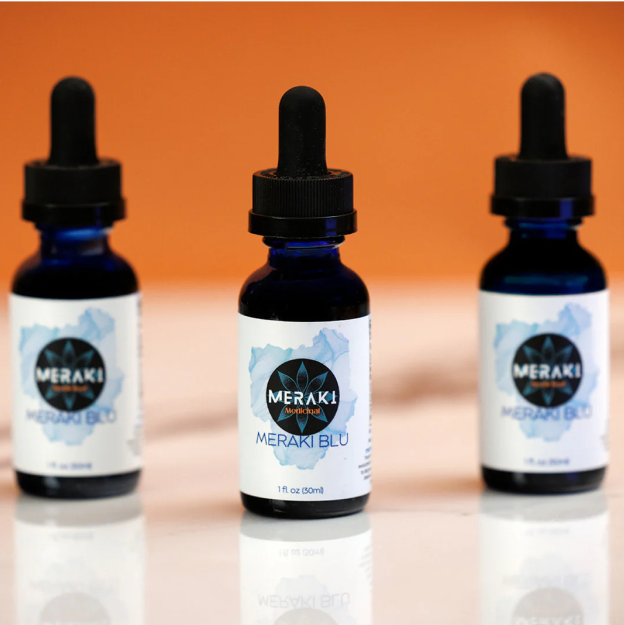
Meraki Blu contains 150 mg of USP-grade methylene blue in a 30 mL bottle. That works out to 5 mg per mL. Our finished-product COA (tested by Nutra Resolutions, Lot #081225) confirmed 5.27 mg/mL via HPLC.
The standard dropper produces approximately 20 drops per mL.
1 drop of Meraki Blu ≈ 0.25 mg of methylene blue.
This matters because not all MB products are the same concentration. A 1% solution delivers 0.5 mg per drop. Meraki Blu is formulated to deliver a lower amount per drop, which makes precise low-dose titration easier. You can dial in your dose one drop at a time without overshooting.
If you're switching from another product, recalculate. The drop count that worked with a different concentration won't apply here.
Methylene Blue Dosage Chart for Meraki Blu
Based on Meraki Blu's concentration: 1 drop ≈ 0.25 mg
Studies show doses between 5 and 15 mg are effective for the antioxidant and cognitive properties of methylene blue. 90% of our customers report 5 mg as their go-to daily dose.
Based on Meraki Blu’s 0.5% concentration (0.25 mg per drop):
| Goal | Daily Drops | Daily Dose | Notes |
|---|---|---|---|
| Beginner (testing tolerance) | 1-3 drops | 0.25-0.75 mg | Start here regardless of body weight |
| Low dose (maintenance) | 4-12 drops | 1-3 mg | Where most beginners settle after week 1 |
| Standard dose (most common) | ~20 drops | ~5 mg | 90% of our customers report this as their daily dose |
| Higher dose (experienced users) | 20-40 drops | 5-10 mg | Consider professional guidance |
| Upper range | 40-60 drops | 10-15 mg | Only under professional guidance |
A few things to notice about this chart.
The beginner dose is the same for everyone. Whether you weigh 120 pounds or 220 pounds, start with 1 to 3 drops. This isn’t about body weight. It’s about seeing how your body responds to a compound it’s never encountered before. Some people feel a noticeable shift in clarity from a single drop. Others need a full week at 3 drops before they notice anything.
The “standard dose” of roughly 5 mg (about 20 drops) is based on what our customers actually report. Not what a clinical trial protocol calls for. Clinical research typically uses 0.5 to 2 mg per kilogram of body weight, which translates to 35-140 mg for a 154-pound person. Those are not supplement doses. Do not use clinical research dosing as a guide for daily supplementation.
The upper range exists for people working with healthcare professionals who have a specific reason to go higher. We don’t recommend anyone reach 15 mg on their own.
How to Start: Your First-Week Protocol
No guesswork. No ambiguity.
Days 1 through 3: Resonance test.
Start with 1 to 3 drops (0.25 to 0.75 mg). Drop them into a glass of water or juice and drink it in the morning. You're not looking for fireworks. You're letting your body acclimate and checking for any sensitivity.
Pay attention at the 1-hour and 4-hour marks. Any change in energy? Focus? GI comfort? Write it down.
Days 4 through 7: Build to 5–10 drops.
If days 1 through 3 felt fine, move up to 5 to 10 drops (1.25 to 2.5 mg). Same routine: morning, in water, before food. By day 5 or 6, most people start noticing something. It's usually described as a quiet clarity. Like someone cleaned a window you didn't realize was dirty.
If anything feels off, drop back to your Day 1 amount. No rush.
Week 2 and beyond: Find your number.
Increase by 2 to 4 drops every few days. Most people find their sweet spot around 20 drops (5 mg). Some go higher, some stay lower. The goal is the dose where you consistently feel sharper and more energized without any downside. More is not better with MB. Better is better.
Some people cycle: 5 days on, 2 days off. Others take it daily. There isn't strong clinical data favoring one protocol over the other for healthy adults. Listen to your body. If effects seem to fade, a 2-day break often restores full response.
Methylene Blue Dosage by Goal
Different goals tend to point toward different ranges. This makes sense mechanistically — cognitive effects involve brain mitochondrial optimization, while broader energy support requires enough MB to reach tissues throughout the body.
Cognitive Enhancement and Focus
Range: 1 to 5 mg (4 to 20 drops)
This is the best-studied range for brain performance. Gonzalez-Lima's research on healthy adults showed improved sustained attention and memory retrieval at low oral doses. MB crosses the blood-brain barrier efficiently and concentrates in neural tissue, where it supports mitochondrial respiration in neurons that burn through enormous amounts of energy.
Take it in the morning. Cognitive effects typically kick in within 30 to 60 minutes and last 4 to 6 hours.
Daily Energy and Mitochondrial Support
Range: 5 to 10 mg (20 to 40 drops)
If brain fog and afternoon crashes are the problem, you may be dealing with a mitochondrial bottleneck — your cells can't produce ATP fast enough to meet demand. MB at this range provides a bypass route when your electron transport chain gets backed up.
This is where most of our customers land. It's the "I didn't realize how tired I was until I wasn't" range.
Longevity and Cellular Health
Range: 1 to 5 mg (4 to 20 drops), taken consistently
The longevity angle is about consistency more than dose. Animal studies show that MB's effects on oxidative stress markers and cellular health accumulate over time. The hormetic stress at low doses appears to upregulate your cells' own antioxidant defenses, similar to how regular exercise does.
Neuroprotection
Range: 5 to 15 mg (20 to 60 drops) — consult a healthcare provider
Research into MB for neurodegenerative conditions is active and promising, but this is firmly "work with your doctor" territory. Studies on tau protein aggregation and amyloid pathology have used doses at the higher end of the supplement range. This is not self-experimentation territory.
What to Expect (Including the Blue)
Your urine will turn blue-green. Normal. It means MB is being metabolized and excreted. If your urine doesn't change color at all, your dose is very low or your product may not be what it claims.
Your tongue will turn blue. Temporary. Fades within an hour or two. If you've got a meeting, swish water after dosing.
Take it on an empty stomach. MB absorption improves without food competing in your GI tract. Wait 20 to 30 minutes before eating.
Morning dosing is strongly preferred. MB has a mild stimulatory effect on brain metabolism. Taking it after 2 PM may affect sleep. If you're sensitive to anything that touches your energy levels, keep it to mornings only.
Blue sweat is rare but possible. At higher doses, some people notice a faint blue tint on white sheets or clothing. Harmless and dose-dependent.
Interactions and Safety: Read This Section
SSRIs and MAOIs: Serious Danger
Methylene blue is a potent monoamine oxidase inhibitor (MAOI). If you are taking any serotonergic medication — SSRIs (fluoxetine, sertraline, escitalopram), SNRIs (venlafaxine, duloxetine), MAOIs, or tricyclic antidepressants — do not take methylene blue without direct guidance from your prescribing physician.
The combination can trigger serotonin syndrome: agitation, rapid heart rate, high blood pressure, hyperthermia, and in severe cases, seizures. The FDA has issued a specific warning about this interaction. Case reports exist. This is not theoretical.
Other interactions to discuss with your doctor
CYP enzyme interactions. MB can inhibit certain cytochrome P450 pathways, potentially changing how other drugs are metabolized.
G6PD deficiency. MB can trigger hemolytic anemia in people with G6PD deficiency. If you have this condition or aren't sure, get tested before using MB.
Pregnancy and breastfeeding. Insufficient safety data. Avoid MB entirely.
Photosensitivity. MB can increase skin sensitivity to UV light. Wear sunscreen if you're spending time outdoors.
When in doubt, bring your bottle to your doctor's appointment. Show them what you're taking. Have the conversation.
Methylene Blue Dosage FAQ
How many drops of methylene blue should I take?
For Meraki Blu, each drop delivers approximately 0.25 mg. We recommend starting with 1 to 3 drops and gradually increasing. Most adults settle around 20 drops per day (5 mg). Use the dosage chart above to find your starting point, and increase slowly from there.
Can you take too much methylene blue?
Yes. MB follows a biphasic dose-response curve — low doses boost mitochondrial function, excessive doses reverse those benefits and become pro-oxidant. Stay within the 5 to 15 mg range for supplement use. Going beyond that without medical supervision is not recommended. More is not better.
Should I take methylene blue every day?
Many people take MB daily without issues. Some prefer a 5-days-on, 2-days-off cycle to maintain sensitivity. Start with daily use and adjust based on how your body responds.
When is the best time to take methylene blue?
Morning, on an empty stomach. MB has a mild stimulatory effect on brain metabolism, so afternoon or evening dosing may interfere with sleep. Wait 20 to 30 minutes after taking it before eating.
Why does methylene blue turn my urine blue?
MB is excreted through the kidneys, and its deep blue color shows up in urine. Completely normal and actually a useful sign that the compound is being absorbed and processed. The color change is temporary.
Is methylene blue safe with other supplements?
MB is generally compatible with most supplements. Avoid combining it with anything that has serotonergic activity (St. John's Wort, 5-HTP) due to the MAOI interaction risk. If you're stacking multiple supplements, introduce MB on its own first so you can isolate its effects.
How long does methylene blue take to work?
Most people notice cognitive and energy effects within 30 to 60 minutes of an oral dose. Broader mitochondrial support benefits may take 1 to 2 weeks of consistent use to become noticeable as the compound accumulates in tissue.
What is the difference between 1% methylene blue and Meraki Blu?
A 1% methylene blue solution contains 10 mg per mL, with each drop delivering approximately 0.5 mg. Meraki Blu contains 5 mg per mL (150 mg in a 30 mL bottle), with each drop delivering approximately 0.25 mg. This lower concentration per drop makes it easier to start low and titrate gradually. If you're following dosing advice written for a 1% solution, cut the drop count in half for Meraki Blu, or better yet, use the chart on this page.
Start Your Protocol
You've got the research. You've got the dosing framework. You've got a day-by-day plan for your first week.
Everything above assumes you're working with pharmaceutical-grade methylene blue where you know exactly what's in each drop. Meraki Blu is a USP-grade methylene blue solution, tested for heavy metals on every batch, manufactured in an FDA-registered facility in Las Vegas. Every milligram is accounted for.
Start low. Go slow. Trust the process.
[Get Meraki Blu and start your first-week protocol →]
114,000+ customers. 7,000+ verified reviews. Clean Label Project certified.
OTHER RESOURCES