

USP grade vs. industrial grade — and why it matters when the compound crosses your blood-brain barrier
Whatever is in that bottle goes into your bloodstream and crosses into your brain tissue within minutes.
That's not marketing copy. That's how methylene blue works. It's one of the only supplements that passes directly through the blood-brain barrier. No intermediary. No conversion step. It gets into your brain cells, full stop.
Most supplements take a slower route. They pass through your gut, get partially absorbed, and whatever contaminants tag along get filtered by your liver before they reach anything important. Methylene blue skips that entire process.
So the purity question isn't academic. If there's arsenic in the bottle, there's arsenic in your brain. If there are unknown contaminants that nobody tested for, those are along for the ride too.
18,000+ published studies. 140+ years of medical use. The research on methylene blue is settled. What isn't settled is what's actually in the bottle sitting on your counter.
Two grades exist. They're not interchangeable.
USP grade means the compound meets the standards set by the United States Pharmacopeia, an independent nonprofit that's been setting purity benchmarks for drugs and supplements since 1820. For methylene blue, those standards include identity confirmation, a purity threshold of 98%+, heavy metal maximums, and microbiological screening.
This is the standard pharmaceutical companies use when manufacturing injectable methylene blue for hospitals. Provayblue, the only FDA-approved methylene blue product, is made to this standard.
One thing worth clarifying: "USP grade" and "USP verified" are different. USP grade means the raw material meets the monograph specs. USP verified means USP itself audited the manufacturing process and independently tested the product. The verification is expensive, and very few supplement companies go through it. Most brands saying "pharmaceutical grade" are describing the raw material they sourced. That matters. But it's not the whole story.
Industrial grade means the compound was manufactured for labs, textile dyeing, aquarium fish treatment, and other non-human applications. Chemically, it's the same molecule. The manufacturing standards are where things diverge.
When you're staining a microscope slide or treating fish parasites, you don't need pharmaceutical-level contaminant control. So industrial manufacturing doesn't prioritize it.
What can be in industrial-grade MB that shouldn't be in your brain
Unknown contaminants. This is the one that should bother you most. Pharmaceutical-grade manufacturing runs a defined battery of tests for a defined set of potential contaminants. Industrial-grade manufacturing often doesn't test for things it doesn't expect to find. You can't detect what you don't look for.
Heavy metals. The synthesis process can introduce trace amounts of arsenic, lead, mercury, cadmium, chromium, and others. At Meraki, we test every batch for arsenic, cadmium, mercury, and lead via ICP-MS — the same method used in pharmaceutical testing. Our most recent finished-product results came back at or below 0.01 ppm across all four. Most industrial-grade products have never been tested for any of them.
Microbial contamination. Without pharmaceutical-grade controls, bacterial and fungal contamination is a real risk. Our finished-product COA tests for total microbial count, yeast and mold, S. aureus, E. coli, and salmonella. Every batch has come back clean.
Why this matters more for MB than for other supplements
A magnesium supplement passes through your digestive system. Your liver filters it. Multiple biological checkpoints sit between the capsule and your cells.
Methylene blue bypasses all of that.
At the molecular level, MB is an alternative electron carrier in your mitochondrial electron transport chain. It picks up electrons from NADH at complex I and donates them to cytochrome c, providing a detour around blockages at complex III. The exact bypass mechanism is still being refined in the literature, but the core function is clear. This is what Gonzalez-Lima's lab at UT Austin was studying when they documented a 30% increase in cytochrome c oxidase activity in a rat model at 1 mg/kg.
Here's the detail that gets lost in the supplement marketing: Gonzalez-Lima used pharmaceutical-grade methylene blue. Not aquarium treatment. Not textile dye. Purity was part of the experimental protocol, because contaminants would change the results.
When MB crosses your blood-brain barrier and integrates into your electron transport chain, whatever came with it is now inside your brain cells. Heavy metals accumulate over time. Contaminants don't just pass through — they stay.
The research says MB works. The research used pharmaceutical-grade MB. Draw your own conclusion.
How to read a certificate of analysis
A COA is a document showing test results for a specific batch. Most brands have one. Not all COAs are created equal. Here's what to actually look at:
Identity test. Confirms the substance is methylene blue. Sounds obvious, but it matters.
Potency verification. Does the product contain the amount of MB it claims? Our finished-product COA confirms 5.27 g/mL via HPLC, within our 5.0–5.5 g/mL specification. This tells you the dose is accurate. Purity testing on the raw material (before formulation) is a separate step — look for that too.
Heavy metal panel. This is where most COAs fall short. Some test for zero metals. Some test for one or two. We test for four — arsenic, cadmium, mercury, and lead — using ICP-MS on the finished liquid product. All four came back at or below 0.01 ppm in our most recent batch (Lot #081225).
Microbiological testing. Total aerobic count, yeast and mold, specific pathogen screening. Our COA tests for all five.
What the COA covers. This one's critical. A COA for the raw powder is not the same as a COA for the finished liquid product. The raw material might test at 99.9% pure, but bottling, mixing, and storage can introduce new variables.
Reddit's r/methylene_blue community flagged this exact issue. They noticed some brands publish COAs for raw powder, not the finished product consumers actually take. Fair criticism. Any brand serious about transparency should be testing the finished product, not just the ingredient that went into it.
The 5-point checklist before you buy
1. What grade is the raw material? USP pharmaceutical-grade, or something else? If the brand doesn't specify, assume it's not pharmaceutical-grade. "Pure" and "premium" are marketing words, not grades.
2. Is there an actual, viewable COA? Not "third-party tested" as a badge on the website. An actual certificate with batch numbers, test dates, and results you can read. If they won't publish it, ask yourself why.
3. What does the COA test for? Identity and potency are the bare minimum. Heavy metals and microbiological testing separate real quality control from the appearance of it. Ask how many metals are tested, and by what method. ICP-MS is the gold standard.
4. Is the COA for the finished product or the raw material? Raw material testing tells you about the ingredient. Finished product testing tells you about what's in the bottle. Both matter. The bottle matters more.
5. Where is it manufactured? An FDA-registered facility in the US operates under cGMP guidelines. An unknown facility in an unregulated market doesn't. Meraki Blu is made in Las Vegas, Nevada in an FDA-registered facility.
Here's Meraki's COA dated 9/8/25.
Frequently asked questions
Is industrial-grade methylene blue dangerous?
Not necessarily in the short term. Plenty of people have taken industrial-grade MB without obvious acute effects. The concern isn't immediate toxicity. It's what happens over months and years of cumulative exposure to trace contaminants you wouldn't know about without testing. Heavy metals accumulate. And with a compound you take regularly that crosses your blood-brain barrier, "probably fine" shouldn't be the standard.
What about methylene blue from Amazon?
Most MB on Amazon is sold as a "research chemical" or for aquarium use. Some of it is pharmaceutical-grade. Most isn't. Listings rarely include COAs or heavy metal results. The price is also a tell. If a bottle costs $8-15, the economics of pharmaceutical-grade manufacturing, third-party testing, and FDA-registered facility production don't work.
Does the form factor matter? Drops vs. capsules vs. troches?
Form factor affects convenience and onset time. The grade of the active ingredient matters more. A troche made with industrial-grade MB and a liquid drop made with pharmaceutical-grade MB aren't comparable products, regardless of delivery method.
How do I know Meraki Blu is really pharmaceutical-grade?
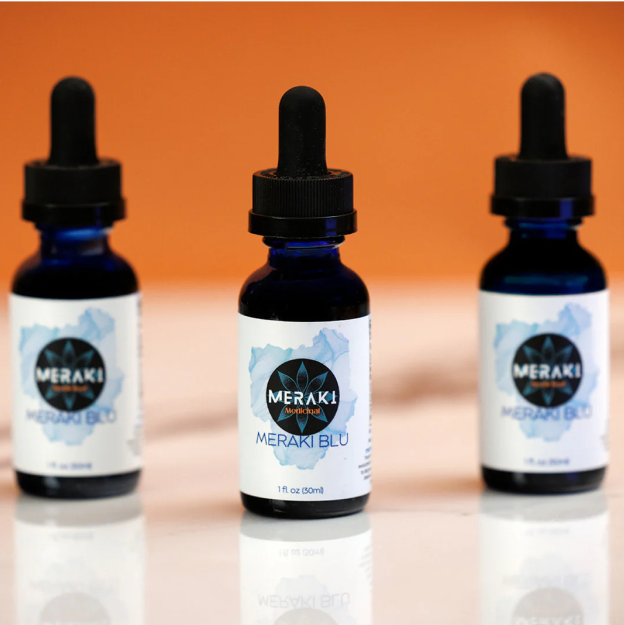
We publish our lab results — including finished-product COAs with batch numbers you can verify. We're Clean Label Project certified. We test every batch for heavy metals (arsenic, cadmium, mercury, lead) and run a full microbiological panel. We manufacture in an FDA-registered facility in Las Vegas. We have 114,000+ customers and 7,000+ verified reviews averaging 4.47 out of 5 stars. None of those are claims you have to take our word for. They're all verifiable.
What about the Reddit criticism that Meraki's lab results are for powder, not the finished liquid?
We heard that feedback, and we agree — finished-product testing is the standard that matters. Our COA from Nutra Resolutions (Lot #081225, dated September 2025) tests the finished liquid product, not the raw powder. Sample name on the certificate: "Methylene Blu (finished product)." We publish it because the bottle is what you're actually taking.
Why we built this
The methylene blue market is growing fast. Mainstream media is covering it. More brands launch every month. Most of them say the same things: "pharmaceutical grade," "third-party tested," "pure."
We didn't start Meraki because the market needed another brand repeating those words. We started it because we wanted to take methylene blue ourselves, looked at what was available, and couldn't verify the claims anyone was making.
Methylene blue is the only compound most people will ever take that crosses the blood-brain barrier and directly participates in mitochondrial electron transport. It's not a multivitamin. It's not a protein powder. It's a pharmaceutical compound with a 140-year medical history, and the researchers who study it — Gonzalez-Lima, Seyfried, Tucker, Rojas — use pharmaceutical-grade material for a reason.
If you're taking something that goes directly into your brain cells and plugs into your electron transport chain, the grade of that something matters.
Industrial-grade MB was made for microscope slides and fish tanks. Pharmaceutical-grade MB was made for the human body.
114,000+ people decided they wanted the real thing.
[Try the MB you can actually trust →]
$35. 114,000+ customers. 7,000+ verified reviews. Clean Label Project certified.