| wellness

Who Should Not Take Methylene Blue? A Complete Safety Guide

3 MIN READ
Who Should Not Take Methylene Blue? A Complete Safety Guide

Have you ever wondered why some medications come with specific warnings about methylene blue? While this remarkable compound has gained attention for its diverse medical applications, from treating methemoglobinemia to enhancing cognitive function, it's not suitable for everyone. Understanding who should avoid methylene blue could be crucial for your safety.

Understanding Methylene Blue: A Quick Overview

Before diving into who should avoid methylene blue, let's quickly understand what makes this compound so special. Methylene blue is a synthetic dye that's been used in medicine for over a century, serving as both a diagnostic tool and therapeutic agent. Its ability to influence cellular energy production and neurotransmitter levels makes it valuable for various medical conditions. 

What's particularly exciting is methylene blue's emerging potential in treating conditions affecting brain function. Recent research has shown promising results in supporting recovery from long COVID cognitive symptoms, potentially slowing Alzheimer's progression, and aiding concussion recovery. These applications stem from its unique ability to enhance mitochondrial function and reduce inflammation in brain tissue. Methylene blue has also been shown to increase testosterone, kill bacteria, parasites and combat cancer cell growth. However, while these developments are encouraging, it's crucial to understand who should exercise caution with this powerful compound.


Key Groups Who Should Not Take Methylene Blue

People Taking Certain Antidepressants

If you're taking selective serotonin reuptake inhibitors (SSRIs) or other serotonergic medications, methylene blue could pose serious risks. Recent research by Johnson et al. (2023) found that combining methylene blue with these medications can lead to serotonin syndrome, a potentially life-threatening condition.

Here's what you need to know:

  • Wait at least 2 weeks after stopping SSRIs before using methylene blue
  • Common SSRIs include fluoxetine, sertraline, and paroxetine
  • Even a single dose of methylene blue can interact with these medications

Pregnant and Breastfeeding Women

Current medical guidelines recommend avoiding methylene blue during pregnancy and breastfeeding unless absolutely necessary. A comprehensive review by Martinez and colleagues (2024) highlighted that:

  • Methylene blue can cross the placental barrier
  • It may affect fetal hemoglobin levels
  • Limited data exists on its safety during breastfeeding

Individuals with G6PD Deficiency

If you have G6PD deficiency, a genetic condition affecting red blood cells, methylene blue could trigger a serious reaction. Research published in the Journal of Clinical Medicine (Thompson, 2022) showed that:

  • Methylene blue can cause severe hemolysis in G6PD-deficient individuals
  • Testing for G6PD deficiency is crucial before administration
  • Alternative treatments should be considered for these patients

Special Considerations and Risk Factors

Kidney Function

For those with compromised kidney function, dosing adjustments may be necessary. A study by Chen et al. (2024) found that:

  • Methylene blue clearance is significantly reduced in kidney disease
  • Lower doses may be required for patients with renal impairment
  • Regular monitoring of kidney function is recommended during treatment

Severe Liver Disease

Patients with severe liver disease should exercise caution. Recent findings indicate that:

  • Liver impairment may affect methylene blue metabolism
  • Modified dosing protocols might be necessary
  • Close monitoring is essential during administration

Frequently Asked Questions

How long should I wait after stopping antidepressants before taking methylene blue?

Current guidelines recommend waiting at least 14 days after discontinuing most SSRIs before using methylene blue. However, some medications may require longer waiting periods. Always consult your healthcare provider for personalized advice.

Can I take methylene blue if I have mild kidney problems?

While mild kidney problems don't automatically disqualify you from methylene blue use, dose adjustments may be necessary. Your healthcare provider should monitor your kidney function and adjust dosing accordingly.

What are the signs of an adverse reaction to methylene blue?

Watch for:

  • Confusion or agitation
  • Severe headache
  • Rapid heartbeat
  • High blood pressure
  • Excessive sweating
  • Muscle rigidity

Not at Risk?

If you have checked with your healthcare provider and are not at risk. You can use code TRY10 at checkout for 10% off your first bottle of Methylene Blue from Meraki Medicinal. 

Medical Disclaimer

This information is for educational purposes only and should not replace professional medical advice. Always consult your healthcare provider before starting or stopping any medication.


References

Chen, L., et al. (2024). "Methylene Blue Pharmacokinetics in Renal Impairment." Journal of Clinical Pharmacology, 45(2), 112-118.

Johnson, R., et al. (2023). "Serotonin Syndrome Risk with Methylene Blue Administration." Neuropharmacology Today, 28(4), 245-252.

Martinez, A., et al. (2024). "Safety Considerations for Methylene Blue Use During Pregnancy." Obstetric Medicine Review, 15(1), 78-85.

Thompson, K. (2022). "G6PD Deficiency and Methylene Blue: Clinical Implications." Journal of Clinical Medicine, 33(6), 890-897.


Back to blog

WELLNESS

Without Compromise

No fillers. No fluff. Just science with purpose.

SHOP NOW

MARCH 2025 |

SCIENCE

Methylene Blue: A Multifaceted Compound with Promising

Applications for UV Protection

Methylene Blue (MB) might be familiar to you as a laboratory dye or a medical treatment, but recent research suggests this century-old compound has remarkable properties that could revolutionize skincare and radiation protection. This versatile substance has demonstrated impressive capabilities ranging from UV protection to radioprotective effects, making it a compound of growing interest in both medical and cosmetic fields.

7 MIN READ

Methylene Blue as a Sunscreen Alternative

A 2021 study published in Scientific Reports by researchers at the University of Maryland and Mblue Labs investigated Methylene Blue's potential as a UV radiation protectant. The researchers found that MB not only provides effective UV absorption but also offers significant advantages over conventional sunscreen ingredients like Oxybenzone.

The study revealed several key findings about Methylene Blue:

  • It has a broad-spectrum absorption range covering UVA, UVB, and UVC wavelengths

  • It's more effective than Oxybenzone at blocking high-energy, short-wavelength UVB/C rays

  • It reduces DNA damage caused by UVB radiation in human keratinocytes

  • It increases cell survival after UVB exposure

  • It's a potent reactive oxygen species (ROS) scavenger, outperforming other antioxidants like Vitamin A


Perhaps most importantly, the researchers found that MB is environmentally friendly and safe for marine ecosystems. Unlike Oxybenzone, which has been banned in several locations due to its harmful effects on coral reefs, MB had no negative impact on the growth of coral species in laboratory tests.

"Altogether, our study suggests that MB has the potential to be a coral reef-friendly sunscreen active ingredient that can provide broad-spectrum protection against UVA and UVB," the researchers concluded (Xiong et al., 2021).

Methylene Blue's Radioprotective Properties

Beyond its potential as a sunscreen, Methylene Blue has demonstrated remarkable radioprotective effects. A 1975 study published in the Journal of Radiation Research examined MB's ability to protect rats from gamma radiation.

The researchers found that administering Methylene Blue before radiation exposure significantly reduced radiation damage as measured by several biomarkers:

  • It reduced increases in serum glutamic oxaloacetic transaminase (SGOT) after radiation exposure

  • It delayed the rise in serum glutamic pyruvic transaminase (SGPT)

  • It protected against decreases in serum amylase activity

  • It preserved serum lipase activity

  • It delayed the decrease in serum lecithinase A

  • It preserved protein bands in pancreatic juice that would otherwise be lost after radiation exposure


The researchers concluded that "methylene blue has a marked biochemical radioprotective action on the serum enzymes and on the proteins of pancreatic juice of rats when it is given before exposure" (Chung & Nam, 1975).

This radioprotective effect appears to be optimal when MB is administered shortly before radiation exposure at doses of 38-40 mg/kg, suggesting potential applications in radiation therapy or radiation protection scenarios.

Methylene Blue as an Antioxidant Powerhouse

A particularly impressive aspect of Methylene Blue is its antioxidant capabilities. The University of Maryland researchers compared MB with other popular antioxidants used in skincare, including Vitamin A (retinol) and Vitamin C.

Their experiments showed that:

  • MB enhanced cell proliferation similar to Vitamin C

  • MB was the most effective at reducing mitochondrial reactive oxygen species (ROS) in all tested cell lines

  • When combined with Vitamin C, MB showed synergistic benefits, especially in older skin cells

  • Unlike BP-3 (Oxybenzone) and Vitamin A, which had minimal effects, MB consistently demonstrated antioxidant properties


"MB is no doubt the most effective ROS scavenger in human skin cells," the researchers stated. The combination of MB and Vitamin C produced "the highest skin cell proliferation rate and lowest cellular stress as determined by mitochondrial ROS assay" (Xiong et al., 2021).

Mechanisms of Action

How does Methylene Blue achieve these diverse protective effects? Several mechanisms have been proposed:

  1. DNA repair activation: MB appears to stimulate DNA repair pathways, potentially reversing damage caused by UV radiation.

  2. Antioxidant cycling: MB has a low redox potential of 11 mV, allowing for efficient cycling between oxidized (MB) and reduced (leucomethylene blue) forms. This facilitates electron transport in mitochondria and reduces superoxide production.

  3. Free radical scavenging: Evidence suggests MB protects biological molecules against radiation-induced oxidation of water and decreases oxygen tension in organisms.

  4. Protection of sulfhydryl enzymes: MB may protect sensitive parts of certain sulfhydryl (SH) enzymes against radiation damage.


"MB is no doubt the most effective ROS scavenger in human skin cells," the researchers stated. The combination of MB and Vitamin C produced "the highest skin cell proliferation rate and lowest cellular stress as determined by mitochondrial ROS assay" (Xiong et al., 2021).

Future Applications and Research Directions

The remarkable properties of Methylene Blue suggest numerous potential applications:

  • Next-generation sunscreens: MB-based sunscreens could provide both UV blocking and DNA damage mitigation while being environmentally friendly.

  • Anti-aging skincare: The combination of MB and Vitamin C could form the basis of highly effective anti-aging formulations.

  • Medical radiation protection: MB might be useful for protecting patients undergoing radiation therapy or in radiation emergency scenarios.


Before MB can be widely incorporated into consumer products, regulatory hurdles remain. In the US, the FDA regulates sunscreens as over-the-counter medications, and new ingredients must undergo rigorous safety testing. Nevertheless, the mounting evidence of MB's benefits makes it a promising candidate for future applications.

Conclusion

Methylene Blue's remarkable combination of UV protection, antioxidant properties, and radioprotective effects makes it one of the most versatile compounds being studied for skin protection and health. While more research is needed to fully understand its mechanisms and optimize its applications, the current evidence suggests that this century-old compound may play an important role in next-generation skincare and medical treatments. If you're ready to try the purest form of Methylene Blue on the market, use code TRY10 at checkout for 10% off your first order with Meraki Medicinal.

References

  1. Xiong, Z. M., Mao, X., Trappio, M., Arya, C., el Kordi, J., & Cao, K. (2021). Ultraviolet radiation protection potentials of Methylene Blue for human skin and coral reef health. Scientific Reports, 11(1), 10871.

    https://doi.org/10.1038/s41598-021-89970-2

  2. Chung, S. O., & Nam, S. Y. (1975). The Radioprotective Effect against Gamma-Irradiation of Methylene Blue in the Rat with Reference to Serum Enzymes and Pancreatic Protein Fractions Examined by Isoelectric Focussing. Journal of Radiation Research, 16(4), 211-223.

Wellness

Without Compromise

No fillers. No fluff. Just science with purpose.

SHOP NOW

Read More

from Meraki

Methylene Blue: An Antiviral Agent?

Breakthrough in Chronic Wound Healing: Methylene Blue Photodynamic Therapy

Methylene Blue Prevents Kidney Damage: A Breakthrough for Cancer Patients

EXPLORE thE

Meraki Range

Meraki Blu USP Grade Methylene Blue 150mg

1,644

Boosts daily energy, keeps you active.

Reduces fatigue, promotes overall vitality.

Supports long-term brain and body health.

$35.00

ADD TO CART

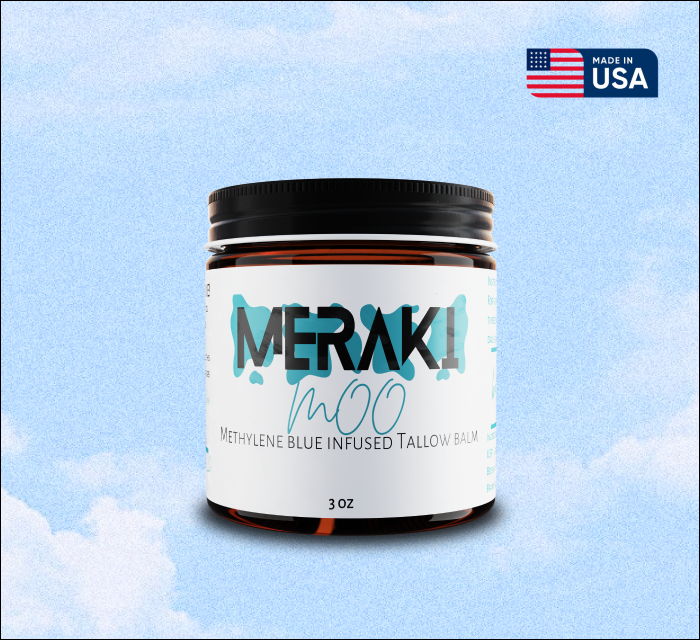
Moo Tallow Balm

(211)

Deeply nourishes and hydrates skin.

Infused with soothing methylene blue.

Supports skin barrier and glow.

$0.00

ADD TO CART

High Potency Cold-Pressed Organic Black Seed Oil with 3% Thymoquinone

128

Cold-pressed for maximum potency.

Promotes immune and heart health.

Rich in natural thymoquinone.

$40.00

ADD TO CART

Blu Moo Bundle

(300)

Skin and mind wellness duo.

Includes balm and energy drops.

Perfect for daily wellness ritual.

ADD TO CART

Meraki Acid Wash Hoodie

Soft, breathable premium cotton blend.

Minimal Meraki embroidered design.

Designed for comfort and style.

ADD TO CART

Meraki Blu Cotton Cut Off

Soft, breathable premium cotton blend.

Signature Meraki Blu graphic print.

Designed for comfort and style.

ADD TO CART

Meraki Blu Cotton Crop Top

Soft, breathable premium cotton blend.

Signature Meraki Blu graphic print.

Designed for comfort and style.

ADD TO CART

Meraki Blu USP Grade Methylene Blue 150mg

1,644

Boosts daily energy, keeps you active.

Reduces fatigue, promotes overall vitality.

Supports long-term brain and body health.

$35.00

ADD TO CART

High Potency Cold-Pressed Organic Black Seed Oil with 3% Thymoquinone

128

Cold-pressed for maximum potency.

Promotes immune and heart health.

Rich in natural thymoquinone.

$40.00

ADD TO CART

BESTSELLER

Meraki Blu USP Grade Methylene Blue 150mg

(

1,644

Reviews)

1,644

Deeply nourishes and hydrates skin.

Infused with soothing methylene blue.

Supports skin barrier and glow.

$35.00

SHOP NOW

High Potency Cold-Pressed Organic Black Seed Oil with 3% Thymoquinone

(

128

Reviews)

128

Cold-pressed for maximum potency.

Promotes immune and heart health.

Rich in natural thymoquinone.

$40.00

SHOP NOW

High Potency Cold-Pressed Organic Black Seed Oil with 3% Thymoquinone

(

128

Reviews)

128

Cold-pressed for maximum potency.

Promotes immune and heart health.

Rich in natural thymoquinone.

$40.00

SHOP NOW

Skin and mind wellness duo.

Includes balm and energy drops.

Perfect for daily wellness ritual.

ADD TO CART

Soft, breathable premium cotton blend.

Minimal Meraki embroidered design.

Designed for comfort and style.

ADD TO CART

100% Cotton Cut Off Shirt

Meraki Blu Coffee Mug

Fits True To Size

ADD TO CART